Castel di Pietra
Not just any medieval castle in Maremma
The Castel di Pietra: not just any Tuscany castle in Maremma.
When a ruined castle holds the secret to an unsolved medieval murder mystery that left suspicion over the head of a Maremma Lord - himself a magistrate - for the greater part of his lifetime and still today. A story that led to the poet Dante writing some lines of script which are probably the most well known words written about Maremma (apart that is from a colloquial sort of blasphemy, "Maremma maiala"!). Then this is a castle to visit. But find it if you can!
 Photo by Opaxir
I live only a few kilometres away from the Castel di Pietra, and have tried to find it on two occasions over the years, but failed both times. But I wasn't about to give-up this time. Especially as I had both my husband and daughter in tow - my daughter had been with me on my second attempt and wasn't that impressed about mum trying again! - who had much rather gone to the coast: I needed to show them a castle!
Finally, a couple of days after Halloween, with the November afternoon light fading fast on us, we found it. But only just, and despite a hand-drawn map from a friend of a friend who knows it well!

There is something magical about castles - the ruins of castles to be more accurate, not the bedecked and lived-in Baronial hall type - that has always attracted me to them. To walk amongst the "rooms" that remain, to touch the same stones of the walls and fireplaces that women had cleaned and stoked centuries ago. To imagine the lives, loves and hardships that those same walls witnessed and now hold the stories of so tightly. Our histories. And all under a roof of stars.

The castello is a crumbling ruin, not big at all - but it once was - that if you don't have a passion for castles like I do, when/if you get there after those in your group keep asking how much further and are you sure it is there... you will wonder why on earth I told you in this page to go.
But if you do, and history and mysteries fascinate you, then this castle in particular is the one to visit in Maremma. To touch the love story of the heads of two ruling medieval families, a lord and the last noble lady of Maremma. A story that survived claims of bigamy incest and more, that was well and truly messed with by the Pope, but still survived. Only to end in tragedy and separation. And another mystery.
Panoramic view
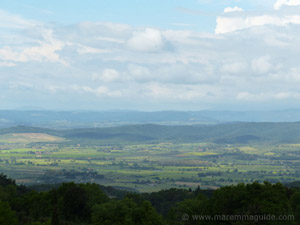
From the castle's grounds you can also see the hill top "castelli" (castles) of Montemassi and Tatti, as well as the hill towns of Sticciano and Montepescali.
A little of a lot of history

The middle ages castle of Castel di Pietra was built on a strategic high point in the southern metalliferous hills of Maremma Grossetana to guarantee the control of mining activities and the production of lead, silver, iron and vitriol in the surrounding area. Once dominating the valley of the River Bruna, it is now lost from sight in woodland.
The first occupation of the hill was in prehistoric times, with a small settling in a cave opening in the hill below the castle.
Pre-medieval buildings on the summit of the hill started in the Hellenistic Etruscan age (II-III centuries), with Etruscan re-occupation in the VI-VII centuries.
La Rocca di Pietra (the fort of stone) XI-XII centuries
Documentary mention of the castle began in 1067, when it was known as the "Rocca di Pietra" and listed amongst the properties of the "Abbazia di Sestinga" - the Abbey of Sestinga of Castiglione della Pescaia, under the control of the influential Bishop of Roselle.
The Castel di Pietra (the castle of stone) XII-XIII centuries

Then, importantly, during the first years of the eleventh century, the fortification ceased to be referred to as a "rocca" - fort - and assumed the status of castle under the ownership and occupancy of the powerful Aldobrandeschi family in Maremma.
In 1203 the inhabitants of the castle prevented the safe transit of salt that did not originate from the warehouses of the Aldobrandeschi family or Siena - a pact between the head of the family, Lord Ildebrandini VII, and the city of Siena. In 1307 the Comune of Massa Marittima installed a Lord and four soldiers at Castel di Pietra with a precise charge to control the communication route between the hills and the plain of Grosseto.
From the middle of the thirteenth century, the control of the castle passed from the Aldobrandeschi family to their vassals and arch rivals the Pannocchieschi family. Despite submitting control of the castle and its lands to the city of Siena in 1263, the Pannocchieschi family exercised considerable autonomy and rule until the beginnings of the fifteenth century.
My young daughter and husband re-named the Castel di Pietra as "Nipitella Castle", for when you walk around it your footsteps release a wonderful sweet aromatic scent, the dominating one being of the herb used in mushroom pasta dishes here, Nipitella. There is also "Rosmarino" (Rosemary) and "Timo" (Thyme) growing in the grounds and around.
Castel di Pietra: War and ruin - XIV century
Successive and increasingly aggressive political and military campaigns between the Comunes of Massa Marittima and Siena to include the castle within their rule led to a significant diminishment of the power of the Pannocchieschi family and, in 1328 after the death of the head of the family, Lord Nello d'Inghiramo Pannocchieschi, the castle fell under the rule of the Comune of Massa Marittima.
In the second half of the fourteenth century and concurrent with the claim to the castle by the Sienese families of Tolomei and Malavolti, Castel di Pietra went into decline and was progressively abandoned. Completely so from 1413.
Highly recommended websites for more information

Excavations that commenced in 1997, led by the University of Siena, have revealed much more information, such as the existence of a complex urban system from the year 1200. And unearthed many household ceramics, 338 coins from Pisa, Siena, Lucca, Arezzo, Massa Marittima and Florence, metal working tools, and archaic maiolica enameled Renaissance ceramics from Siena, Pisa and Volterra.
For details of the excavation and more photographs of the castle, visit the website of MediArg Medieval Archeology Grosseto.
For a drawing of what the castle would have looked like at its height of use visit the website* of Portale di Archeologia Medievale Dipartimento di Archeologia e Storia della Arti Area di Archeologia Medievale. Click on the red link beneath the sketch to enlarge the image. The navigation menu on the left of that page will also take you to pages rich with information about the castles history from the very first Etruscan civilisation established there.
*The website is no longer available.
NOTE: Both websites are, naturally, in written Italian, but if you enter the website address into the Google Translate service, although not perfect, the translations are good enough to allow you to have access to the superb information these sites contain.
The story of Lord Nello dei Pannocchieschi
e Lady Pia de Tolomei
Legend has it that it was in Castel di Pietra that Nello d'Inghiramo Pannocchieschi ordered the execution of his wife Pia di Tolomei on the basis that she had been adulterous and in order that he could marry his mistress the Margherita Aldobrandeschi Contessa of Sovana and Pitigliano.
Pia di Tolomei was a daughter of the powerful Tolomei of Siena family, members of the oldest nobility of Siena. And Nello dei Pannocchieschi was Lord of the Castle, and at different times Chief Magistrate of Volterra and Lucca, and Captain of the Tuscan "Taglia Guelfa".
 The Pre-Raphaelite painting of Pia de Tolomei by Dante-Gabriel Rossetti
Despite protesting her innocence, Pia was imprisoned in the castle and then murdered by being thrown from a window. After the assassination, the hill upon which the castle sits became known as " Il salto della Contessa" - the Jump of the Contessa. Other stories tell of Pia being poisoned. What is known without doubt, however, is that Nello subsequently married Margherita Aldobrandeschi.
What I found poignant, is that even in November, the open ground along the woodland path below the castle was strewn with Margherita daisies in flower.
Thrown or poisoned, adulterous or not, the story of Pia became a legend and was sufficiently evocative to have captured the attention of both the Italian poet of the middle ages Dante Alighieri and the Pre-Raphaelite painter Rossetti.
 A stone stairwell that would have taken Pia upstairs to her bedchamber in the castle. It now has the herbs Rosemary and Nipitella amongst others growing in the gaps between the stones.
 A marble plaque on the external wall of the castle, celebrating in 1921 the six hundredth death of the poet Dante.
The "Salta della Contessa" Festival
Each August the town of Gavorrano holds a costumed medieval festival called the "Salto della Contessa" in remembrance of Pia's tragic death at the Castel di Pietra.
Getting there
I'll make it easy :)
 Photo by Opaxir
Now everyone who lives locally will tell you to take the dirt track at the large rock along the road. Trouble is there are two large rocks both marking the beginning of private access tracks and the one you want - well when I visited - is covered in bushes! You'll need the keen eye of a youngster in the back of the car to spot it!
Note. There is a medieval borgo" at which you can also find the Tenuta di Pietra called Castel di Pietra: this isn't the location of the castle.
Anyway, if you are travelling from the Gavorrano Scalo to Ribolla along the Strada Provinciale Collacchia road - or join it from Massa Marittima and the hamlet next to the Lago dell'Acessa, La Pesta road - you want to take the single-lane track on your right signposted for Tenuta di Pietra, directly opposite a small and always muddy smallholding with Maremmano cattle.
Then you want the second rock on your right. If you have miss it and arrive in Castel di Pietra the borgo, or are travelling from the Giuncarico to Ribolla Strada Provinciale Castellaccia road, it is the first rock in the bushes on your left that you want. Got it? There's a map below :)
Take the track up the hill, past a lovely large lemon-coloured private villa with its own tower outbuilding, and a little further along you will come to the only place that you can leave your car. Photo below.

From there, don't take the short track to a grey concrete building you can immediately see. It is a dead end and not the "castello".
But take the other one that gives you a glimpse of a gorgeous traditional stone Tuscan house. Go up and up the path ignoring the well overgrown stile originally constructed to prevent cattle that once grazed here from wandering off. There is a tree growing in the middle of it, so you can't walk through anyway!
Until you reach this spot with the buildings immersed within fig trees. They aren't the castle either! It will take you about ten minutes.

The path continues, albeit well overgrown with brambles, to the right and up still onto the highest point where you will find the castle!
 Gnarled old olive trees along the track that have ghoul faces in them!
The map
The satellite route map.
A middle ages castle crumbling away...
After much attention in 1997, the castle is now crumbling away. Since Opaxir took the (KAP) aerial photographs in this page in February 2010, the internal tower structure has collapsed.
So a little safety note...
Not even hard hats will be sufficient for walking amongst the ruins: so this isn't one of those castle ruins that you could happily let your children scramble over. Quite the contrary. There is an old and rotting and displaced no entry sign along the path to the right of the castle, but you have to look for it to see it.
More Maremma castles

Nearby Castello di Montemassi and Tatti castle.
Explore some more...
- FTC Disclosure: If you make a purchase via a link on this site, I may receive a small commission - at no added cost to you. Thank you!
And it's well and truly warm enough for mosquitoes!

Welcome and Ciao!
-

Ciao! I LOVE Maremma. After all the years I have lived here it never ceases to surprise me or bring a smile to my face. Let me show you around.

Don't miss a thing!
-
Hello Donna!
Thank you for your newsletter. It was the highlight of my evening. So beautiful, so interesting, so inviting. I loved every minute of it. Your pictures and descriptions of all that Maremma has to offer are exquisite! I am looking forward to your next newsletter with great anticipation.
Ciao
Georgia Garbini,
Pennsylvania, USAGET YOUR OWN COPY NOW!
Cooking classes
The best and so much fun!
Creative ceramics courses
The perfect pottery Masterclass
Maremma Tours
Private Tuscany tours
About Maremma

Travel Essentials
Eat & Drink
Places to Stay
The Beaches
Hill & Beach Towns
Things to Do
Maremma Real Estate
Everyday Life in Italy
by Donna Stiles. Copyright © 2008-2024 MaremmaGuide.com. All rights reserved.